Two of the grill burners would not light and the third burned unevenly. Salt had eaten the electrodes away. He fitted new ones, reamed the burner ports with the right tool, and set the gas pressure again.
Lysander G.2026-08-06
Independent Viking kitchen appliance repair · Ponte Vedra Beach, FL
Mon–Fri 8–6 · Sat 9–4 +1 (904) 775-7957
St. Johns County · 32082
Marsh-side houses on the Intracoastal, where still overnight air keeps salt in solution for longer and dockside outdoor kitchens take the worst of it.
Marsh Landing sits on the west side of A1A, backing onto the Intracoastal Waterway and the salt marsh that runs alongside it. It was built out from the mid-1980s, and the houses are large, deep-lot and often waterside with a dock. People assume that being off the ocean means less corrosion. In practice it means different corrosion, and in some places worse.
Two mechanisms operate here at once.
The first is that the prevailing wind is easterly for much of the year. Marine aerosol crosses A1A and reaches these lots at a lower concentration than it reaches the dune line, but it reaches them.
The second is local and specific to marsh frontage: still, humid overnight air. Salt deposited on metal is chemically inert while it is dry. It only does damage once it goes back into solution, and what puts it back into solution is dew. On an exposed beachfront lot, morning wind and sun dry surfaces relatively quickly. On a low marsh lot with no breeze at first light, the wet film sits for hours longer. Dwell time, not deposit rate, is what determines how fast a chip in a range grate turns into a bloom.
That is why we see marsh-side hood blowers losing extraction, outdoor grill fasteners and stainless trim age at a rate that surprises owners who thought the marsh was the protected side.
Nearly every waterside lot here has an outdoor cooking area, and a good number of them are close to the water with nothing overhead. Those installations take the worst of the local conditions.
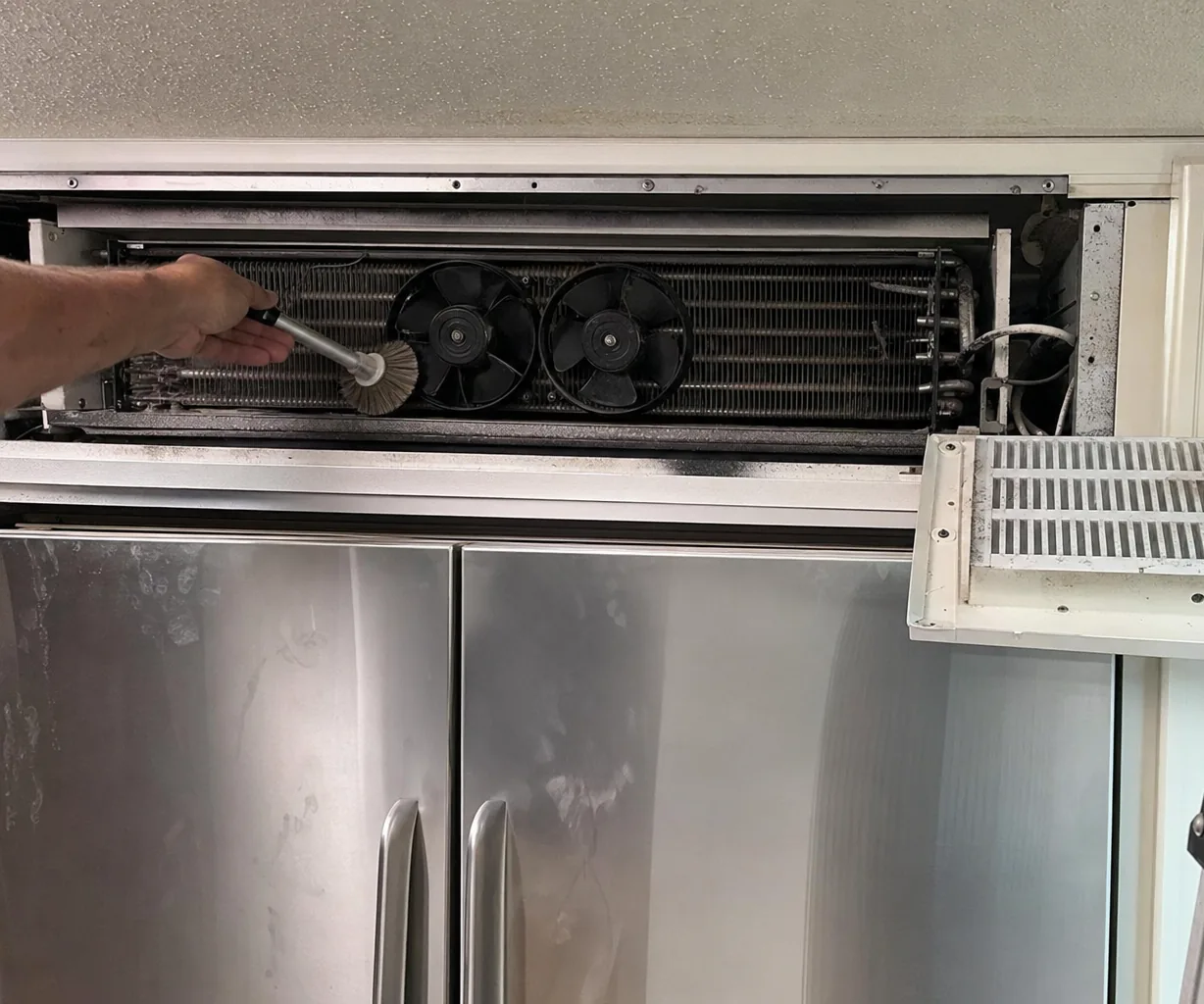
The order of failure is consistent. Fasteners and hinges seize first, and a hinge left seized for a season usually has to be destroyed to come off. Then burner ports block with a mixture of grease and windblown grit. Then the burner tubes themselves corrode through, which shows as flame in the wrong place rather than as an obvious hole. Undercounter refrigeration out there is running against high ambient temperature and a condenser drawing salt-laden air through it.
Covers help and can hurt. A cover put on over a warm, wet grill traps a damp salt film against the metal for the whole night, which is precisely the condition that does damage. Rinse, dry, then cover.
Kitchens here tend to be large, and they tend to have more than one ice maker: the main unit inside, often a second in an outdoor kitchen or a bar, sometimes a third in a garage refrigerator. They are usually the same age and the same design, so when we are called for one we look at all of them.
The order of checks does not change. Freezer compartment temperature comes first, because a mould sitting a few degrees warm produces a slow, partial harvest that imitates every other fault on the list. Then fill: the valve meters by time rather than by volume, so anything that restricts flow — a shut-off valve that was never fully opened, a kinked line, a filter cartridge left in for years — gives short cubes without a single part having failed. Then the harvest itself, where a mould heater or an ejector motor that has lost torque leaves cubes bridged in place. Only then the module or the control board.
That order matters because three of those four cost nothing but time to test, and the fourth is the part most people replace first.
Houses with a dock get a specific extra: equipment is cleaned down with the hose more often, and the overspray reaches the outdoor kitchen. Fresh water is good for salt and bad for electrics. Undercounter refrigeration, ice makers and grill control modules are not built to be washed down. If your dock routine involves a hose near the outdoor kitchen, keep the spray off the appliance faces and their vents, and check that the GFCI protecting them still trips when tested.
Marsh Landing is gated with staffed access, and the lots are deep. Two things make a first visit go smoothly: being on the gate list under the right name, and telling us where the appliance actually is. A wall oven in the main kitchen and a grill at the end of a hundred-foot dock are different appointments, and we would rather bring the right equipment once.
The diagnostic fee is flat and credited toward the repair when you approve the work, with a written estimate before anything is ordered.
What it costs
Flat $80 diagnostic covering the visit and the full diagnostic sequence, credited toward the repair once you approve the work. After that the work falls into bands, and this is the whole book we quote from — parts and labour together, before tax. Nothing above $80 is charged until you have the written figure in your hand and have said yes to it.
| The work | Typical total |
|---|---|
| Diagnostic visit, credited toward the repair | $80 |
| Igniter or burner assembly | $200–$530 |
| Oven thermostat or heating element | $190–$550 |
| Control board or touch panel | $410–$1,000 |
| Refrigeration fan or defrost system | $250–$630 |
| Dishwasher pump or control | $240–$720 |
| Compressor or sealed-system repair | $890–$2,470 |
The spread inside a band is mostly the part, not the hour: the same fault on two machines can want a sensor or a whole assembly. Where a repair would land above $2,470 we say so before ordering anything, and we say it beside what a replacement would cost rather than leaving you to look it up. The full table and what the fee buys, and where a repair stops being worth doing.
Services
$80 flat diagnostic fee, credited toward the repair when you approve the work.
90 days on our labour, 365 days on the parts we supply. Genuine OEM parts.
Questions
Owner feedback
4.2 out of 5 from 80 customer reviews. Each one below is a single visit, written by the person who paid for it. Read all 80.