The touch panel had turned unreliable, sometimes wanting three presses for one command. A ribbon connector behind it had corroded along one edge. He cleaned and reseated it and it responds first time now.
Lorraine C.2026-04-18
Independent Viking kitchen appliance repair · Ponte Vedra Beach, FL
Mon–Fri 8–6 · Sat 9–4 +1 (904) 775-7957
Viking service
Calibration drift, bake and broil element failures, convection motors, door hinges and the latch faults that follow a self-clean cycle.
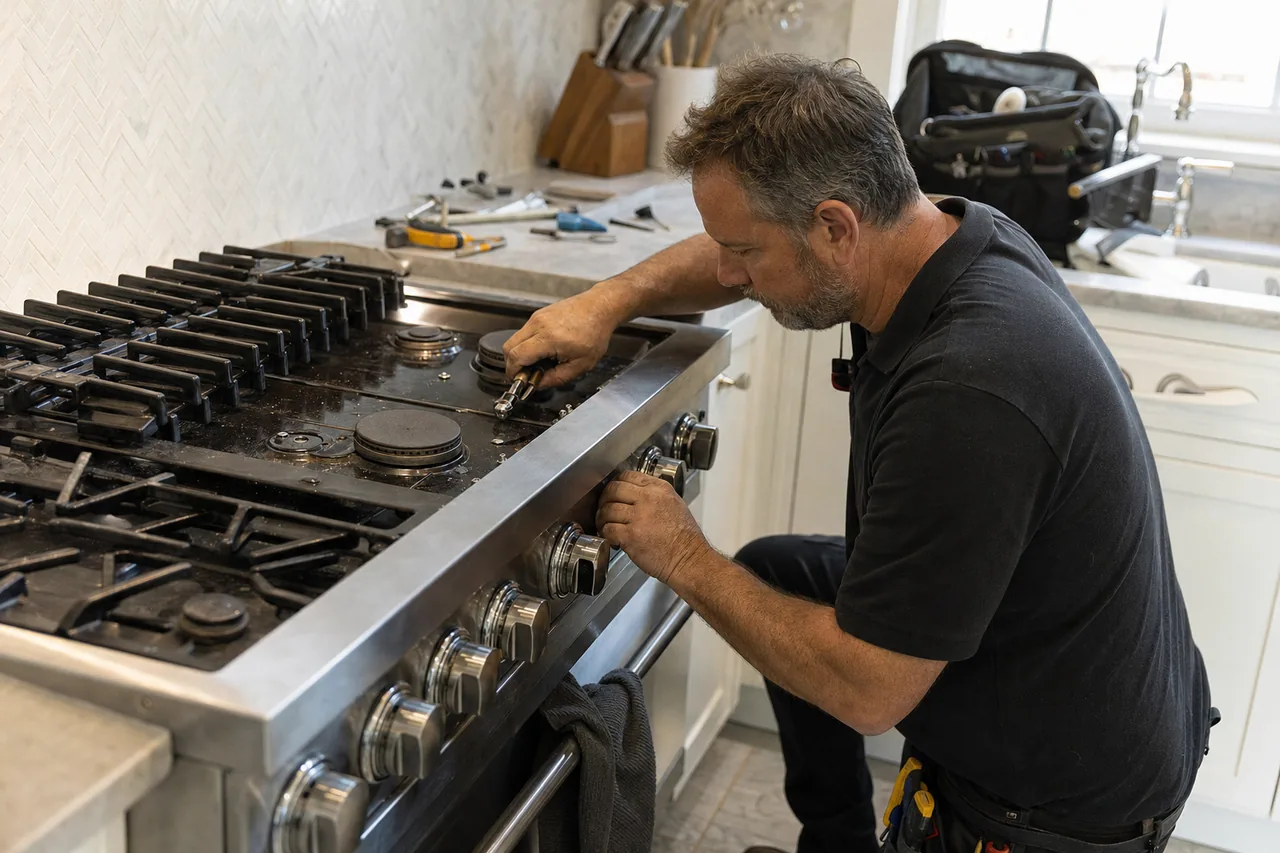
A built-in wall oven fails differently from a range. It is boxed into cabinetry, it usually shares a cavity with a second oven or a warming drawer, and almost everything that goes wrong with it is hidden behind trim that has to come off in a particular order. That is most of why a wall oven repair takes longer on site than the same fault would in a freestanding unit.
The complaint is rarely “the oven is broken”. It is that a recipe that used to take forty minutes now takes fifty, or that the same tray of scones browns on one side. Both point at the temperature sensor and the control that reads it.
Viking wall ovens use a resistance temperature sensor — a probe in the cavity whose electrical resistance rises predictably as it gets hotter. The control board converts that resistance into a temperature. When the probe drifts, the board is not lying to you; it is faithfully reporting a bad number. We measure the probe cold, measure it again at a known cavity temperature with an independent thermometer, and compare the two curves. If the probe reads true and the cavity still runs off, the fault is in the element circuit or the control, and those are different repairs at different prices.
Before any of that, we check whether the oven has simply lost its offset. Most Viking ovens allow a calibration adjustment of a few degrees either way. A unit that is thirty degrees out is not a calibration problem, but a unit that is twelve degrees out often is, and that is a free fix inside the diagnostic visit.
An electric wall oven that heats slowly and browns only from above usually has a failed bake element or an open circuit feeding it. The element itself often looks perfectly normal — a break can be a hairline separation inside the sheath. A meter settles it in a minute.
A gas wall oven that will not hold heat is usually an igniter problem, and the mechanism catches people out. The igniter in a gas oven is also the safety device: the gas valve only opens once enough current is flowing through the glow bar. As the igniter ages it still glows orange and looks fine, but it no longer draws enough current to open the valve. You get a glowing igniter, no flame, and a cold oven. We measure current draw in series rather than judging it by eye.
A wall oven door carries real weight and hangs on two spring-loaded hinges. When one spring weakens, the door sits proud at the top corner, the gasket stops sealing along that edge, and heat escapes past the control panel. Two things follow: the cavity struggles to hold temperature, and the electronics above the door run hotter than they were designed to. A door that no longer closes flush is worth fixing early, because the second-order damage is the expensive part.
The gasket itself is a woven rope seal. It hardens, then it compresses permanently, then it stops touching the frame in the corners. Replacing a gasket is straightforward. Replacing a control board that has been slow-cooked for two years is not.
The pyrolytic cycle takes the cavity far above normal cooking temperatures for several hours. That is exactly the condition under which a marginal thermal fuse opens, a tired door-lock motor jams, and an ageing control board finally quits. If your oven has not been serviced in years and you want it clean before a large dinner, run the cycle a week early, not the morning of. We take more calls about locked, dead ovens in the days before Thanksgiving than at any other time.
We arrive in the booked window, pull the oven forward far enough to reach the junction box and the rear panel, and test rather than guess. You get a written estimate before any part is ordered. The diagnostic fee is flat and is credited toward the repair when you approve it. Parts we supply are genuine OEM, and both the labour and the parts carry the warranty terms published on this site.
Access matters more than people expect. If the oven sits in a tall cabinet with a stone counter returned into it, tell us when you book — that changes the tools we bring and occasionally the length of the appointment.
Symptoms
What it costs
Flat $80 diagnostic covering the visit and the full diagnostic sequence, credited toward the repair once you approve the work. After that the work falls into bands, and these are the bands that fit this page — parts and labour together, before tax. Nothing above $80 is charged until you have the written figure in your hand and have said yes to it.
| The work | Typical total |
|---|---|
| Diagnostic visit, credited toward the repair | $80 |
| Oven thermostat or heating element | $190–$550 |
| Control board or touch panel | $410–$1,000 |
The spread inside a band is mostly the part, not the hour: the same fault on two machines can want a sensor or a whole assembly. Where a repair would land above $1,000 we say so before ordering anything, and we say it beside what a replacement would cost rather than leaving you to look it up. The full table and what the fee buys, and where a repair stops being worth doing.
Related
$80 flat diagnostic fee, credited toward the repair when you approve the work.
90 days on our labour, 365 days on the parts we supply. Genuine OEM parts.
Questions
Owner feedback
4.2 out of 5 from 80 customer reviews. Each one below is a single visit, written by the person who paid for it. Read all 80.