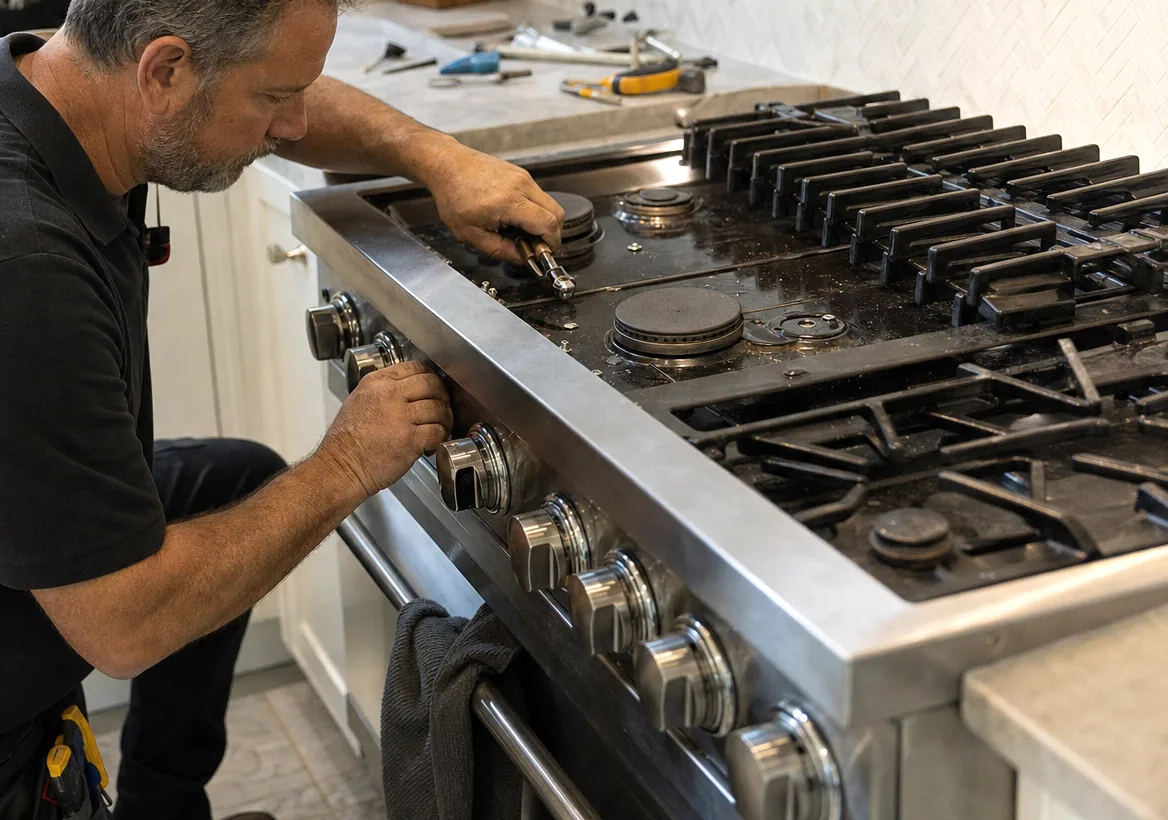
The left front burner lit but dropped to nothing the moment the knob went past medium. He found the orifice partly blocked and the simmer setting out of adjustment, cleaned both and reset the low flame.
Marguerite D.2026-07-28
Independent Viking kitchen appliance repair · Ponte Vedra Beach, FL
Mon–Fri 8–6 · Sat 9–4 +1 (904) 775-7957
coastal
Why porcelain-coated cast iron fails from the chip outward on the coast, and what a monthly ten-minute routine actually prevents.
Porcelain over cast iron is a good coating for a range grate. It is hard, it is easy to clean, and it does not care about heat. What it does not tolerate is a chip.
Salt aerosol settles overnight on every horizontal surface in a house within reach of the Atlantic, and in 32082 that is all of them. Dew forms on the grate in the early hours. The salt goes into solution and sits in the chip, in direct contact with bare iron, for hours.
By morning there is a small rust bloom. Iron oxide occupies more volume than the metal it came from, so the bloom lifts the porcelain at the edge of the chip, which widens the chip, which collects more solution the following night. The process accelerates: the damage in year three is faster than the damage in year one, from the same nightly exposure.
This is why grate corrosion looks like it appears suddenly. It does not. It runs slowly under an intact-looking surface until enough coating has been undermined to flake.
Dry salt is inert. Sodium chloride sitting on dry metal does essentially nothing. The damage happens in solution, so the governing variable is how long the surface stays wet, not only how much salt lands on it.
That has a practical consequence people get wrong. A house on the dune line receives the heaviest deposit but often dries early, because there is wind and sun at first light. A house on the marsh side receives less salt and can hold the wet film until mid-morning because there is no breeze. Both suffer. Neither is the sheltered option.
Stainless is not exempt. Stainless resists corrosion by holding a passive oxide film, and chloride attacks that film locally rather than generally. What you see is not sheet rust but pinpoint staining, usually starting at a scratch, a weld, or a place where something metal has been left sitting. The mechanism is the same as on the grate: a break in the surface, plus chloride, plus time in solution.
Wash the grates and burner caps in warm water and dry them fully — not air-dry, towel-dry — after any night the house was open to the ocean breeze. Salt that is rinsed off before the next dew cannot do any of this. Ten minutes a month is a realistic version of that routine and is worth more than any coating or spray.
Do not use a wire brush or an abrasive pad on porcelain. Every scratch you put in the coating is a future chip.
Once a grate has bloomed through in more than one place it will no longer sit flat, and a grate that rocks will eventually crack. At that stage replacing the grate set is cheaper than repeatedly degreasing and sealing a set that has already gone, and it is safer, because a rocking grate under a heavy pan is a spill waiting to happen.
Hood blower housings. A hood pulls outside air through itself every time it runs, so the housing sees salt on the inside as well as the outside. Remote blowers mounted in an attic or on an exterior wall are the worst case: they live in humid, salt-carrying air, they are never inspected, and they corrode from within while the kitchen end of the system looks new.
Outdoor grill hardware. Fasteners, hinges and drawer slides go first. A seized fastener in a corroded thread often has to be destroyed to remove, so a hinge that is freed and re-set annually stays serviceable and one left for a decade does not.
Door hinge springs and trim screws on the range itself. A hinge that has stiffened on one side lets the oven door hang open a fraction at the top, and from there the gasket stops sealing and the electronics above the door run hotter than they were designed to.
An outdoor kitchen with nothing over it ages several times faster than the same equipment on a covered lanai — not because the rain matters, but because the uncovered installation holds a wet salt film for more hours of the year.
What it costs
Flat $80 diagnostic covering the visit and the full diagnostic sequence, credited toward the repair once you approve the work. After that the work falls into bands, and these are the bands that fit this page — parts and labour together, before tax. Nothing above $80 is charged until you have the written figure in your hand and have said yes to it.
| The work | Typical total |
|---|---|
| Diagnostic visit, credited toward the repair | $80 |
| Igniter or burner assembly | $200–$530 |
| Oven thermostat or heating element | $190–$550 |
The spread inside a band is mostly the part, not the hour: the same fault on two machines can want a sensor or a whole assembly. Where a repair would land above $550 we say so before ordering anything, and we say it beside what a replacement would cost rather than leaving you to look it up. The full table and what the fee buys, and where a repair stops being worth doing.
Related
$80 flat diagnostic fee, credited toward the repair when you approve the work.
90 days on our labour, 365 days on the parts we supply. Genuine OEM parts.
Questions
Owner feedback
4.2 out of 5 from 80 customer reviews. Each one below is a single visit, written by the person who paid for it. Read all 80.